
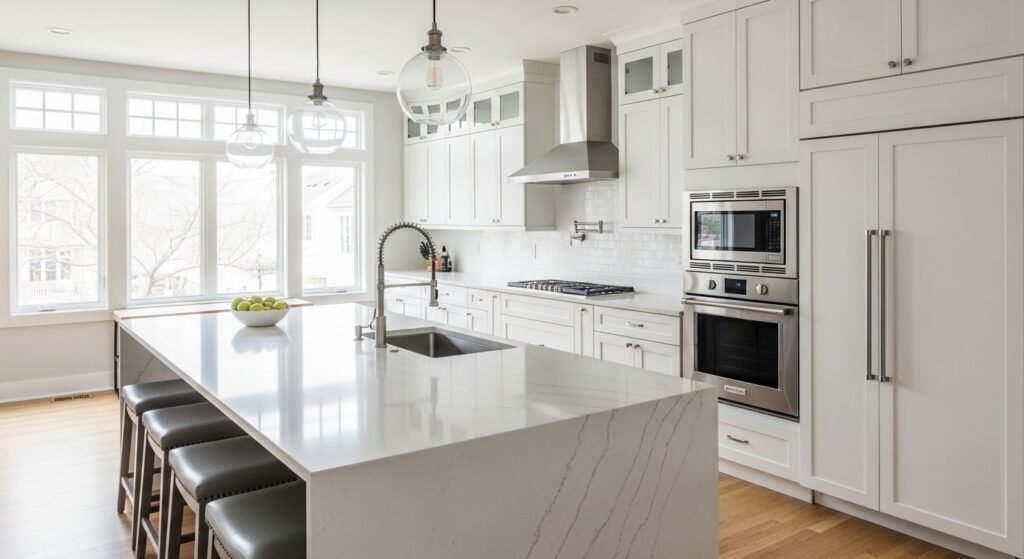
A kitchen renovation changes how your home functions. It’s not just about new cabinets or countertops. It’s about creating a space that works for your daily routine and reflects how you live. A modern kitchen remodel can improve meal prep efficiency, increase storage capacity, and boost your property value by 10-15% according to most real estate assessments.
The key to a successful transformation lies in working with professional kitchen remodeling contractors who understand both design principles and construction realities. Whether you’re planning an affordable kitchen renovation or a complete luxury overhaul, the process requires careful planning and expert execution. Custom Kitchen Designs turn generic spaces into personalized environments that match your cooking style and family needs.
This guide breaks down what a full Kitchen Remodel involves, from initial planning through final installation.
What Does a Full Kitchen Renovation Involve?
A full kitchen renovation means removing and replacing nearly everything in the space. You’re looking at demolition, structural modifications, new electrical and plumbing lines, and complete surface replacement.
The typical scope includes cabinet removal and installation, countertop replacement, flooring installation, lighting upgrades, appliance integration, and backsplash work. Most projects also involve HVAC adjustments, window treatments, and paint or wall finishing.
Demolition and Structural Work
Demolition takes 1-3 days for most kitchens. Contractors remove old cabinets, disconnect appliances, tear out countertops, and strip flooring down to the subfloor. Load-bearing walls require engineering assessments before any modifications.
Some renovations involve opening walls to create better flow between kitchen and dining areas. This adds 2-4 weeks to your timeline and requires permits in most jurisdictions.
Cabinet Installation and Custom Cabinetry
Custom cabinetry installation defines your kitchen’s functionality. Stock cabinets cost $100-300 per linear foot. Semi-custom runs $150-650 per linear foot. Full custom cabinetry starts at $500 and goes up to $1,500 per linear foot.
Custom work lets you maximize corner spaces, create specialized storage for appliances, and build exact-fit solutions for awkward dimensions. You specify drawer depths, shelf heights, and hardware placement based on how you actually use the space.
Countertop Replacement Options
Countertop materials range from laminate at $20-50 per square foot to exotic stone at $200+ per square foot. Installation adds $30-100 per square foot depending on material complexity and edge treatments.
Granite countertops installation remains popular for durability and resale value. Quartz countertops offer consistent patterns and require less maintenance. Laminate countertops work well for budget-conscious projects that still need a clean, modern look.
Kitchen Makeover Variations by Budget
A luxury kitchen remodel ($75,000-150,000+) includes custom everything, high-end appliances, and premium finishes throughout. Mid-range projects ($35,000-75,000) mix semi-custom cabinets with quality materials. Budget renovations ($15,000-35,000) focus on refinishing existing elements and strategic upgrades.
The kitchen renovation cost scales with material choices more than labor in most cases. Cabinets and countertops typically consume 40-50% of your budget.
Style Options for Modern Kitchens
Modern kitchen styles include clean-lined contemporary design, warm transitional aesthetics, industrial elements, and minimalist Scandinavian approaches. Each style drives different material and layout decisions.
A rustic kitchen remodel emphasizes natural wood, exposed beams, and vintage-inspired hardware. Farmhouse kitchen remodel projects feature apron-front sinks, open shelving, and shaker-style cabinets. Contemporary kitchen design uses flat-panel cabinets, minimal hardware, and integrated appliances.
Your style choice should match your home’s overall architecture. A modern kitchen in a Victorian house creates visual disconnect unless carefully integrated.
Choosing the Right Kitchen Features and Styles for Your Remodel
Features determine how your kitchen performs under daily use. The wrong layout or missing elements create frustration that lasts for years.
Kitchen Island Design
A kitchen island adds 25-50 square feet of work surface and storage. Standard islands measure 4×8 feet or 3×6 feet for smaller kitchens. You need 42-48 inches of clearance on all sides for comfortable traffic flow.
Island options include prep sinks, cooktop integration, seating areas, and appliance storage. An island with seating requires 12-15 inches of overhang and 24 inches of width per seat.
Multi-level islands separate prep areas from dining surfaces. This works well in open-concept homes where the kitchen island serves as a visual room divider.
Backsplash Installation
Backsplash installation protects walls from moisture and food splatter while adding visual interest. Standard height runs from countertop to bottom of wall cabinets (usually 18-20 inches).
Ceramic tile costs $5-15 per square foot installed. Glass tile runs $15-30 per square foot. Natural stone reaches $25-50 per square foot depending on material and pattern complexity.
Full-height backsplashes create dramatic focal points behind ranges or in open wall sections. This approach works best with simple tile patterns to avoid visual chaos.
Kitchen Flooring Installation
Kitchen flooring installation requires materials that handle moisture, dropped objects, and constant foot traffic. Options include luxury vinyl plank ($3-7 per square foot), ceramic tile ($5-15 per square foot), and hardwood ($8-25 per square foot).
Luxury vinyl plank offers the best durability-to-cost ratio for most kitchens. It resists moisture better than hardwood and provides softer footing than tile. Installation takes 1-2 days for average kitchens.
Heated floors add $8-15 per square foot but transform comfort in cold climates. They require early planning since installation happens during the subfloor phase.
Open Shelving Kitchen Design
Open shelving kitchen design removes upper cabinets from one or more walls, creating an airier feel. This works well in small kitchens that feel cramped with full cabinet coverage.
The tradeoff: open shelves require organized storage habits. Everyday dishes become part of your visual design. You lose some dust protection and enclosed storage capacity.
Most successful designs mix open shelving with closed cabinets. Put frequently-used items on open shelves near prep areas. Keep closed cabinets for pantry goods and less attractive necessities.
Kitchen Sink Installation
Kitchen sink installation options include undermount, drop-in, and farmhouse styles. Undermount sinks ($200-800) create clean countertop lines and easy cleanup. Drop-in sinks ($100-400) install faster and work with any countertop material. Farmhouse sinks ($300-1,200) make visual statements but require modified cabinet bases.
Single-bowl sinks maximize space for large pots. Double-bowl configurations separate food prep from cleanup zones. Add $200-400 for touchless faucets that improve hygiene and convenience.
Smart Appliances and Modern Features
Smart appliances connect to home networks for remote control and automated functions. Smart refrigerators track inventory and suggest recipes. Connected ovens preheat on schedule and send completion alerts to your phone.
The practical value varies by lifestyle. Remote preheat works well if you have predictable routines. Inventory tracking helps if you struggle with meal planning and grocery shopping.
Energy-efficient kitchen appliances reduce operating costs by 10-30% compared to standard models. ENERGY STAR dishwashers use 3-5 gallons per cycle versus 10 gallons for older units. Induction cooktops deliver 85% thermal efficiency compared to 65% for gas ranges.
LED Lighting and Under-Cabinet Solutions
LED lighting consumes 75% less energy than incandescent bulbs and lasts 25 times longer. Color temperature matters: 2700-3000K creates warm ambiance, 3500-4000K suits task lighting, 5000K+ feels clinical.
Under-cabinet lighting eliminates shadows on countertop work surfaces. Puck lights create focused pools of light. Linear strips provide even illumination across entire counter lengths. Motion-activated options add convenience for late-night kitchen visits.
Install separate controls for ambient, task, and accent lighting. This lets you adjust brightness based on activity and time of day.
Transitional Kitchen Remodel Elements
A transitional kitchen remodel blends traditional warmth with contemporary clean lines. Think shaker cabinets with modern hardware, marble counters paired with industrial lighting, or painted cabinets mixed with natural wood islands.
This style offers the widest appeal for resale since it doesn’t commit fully to trend-dependent design choices. Transitional kitchens age well because no single element dates the space.
Eco-Friendly Kitchen Renovation Options
An eco-friendly kitchen renovation reduces environmental impact through material selection and energy efficiency. Bamboo cabinets grow back in 5-7 years versus 20-30 for hardwoods. Recycled glass countertops divert waste from landfills. Low-VOC paints and adhesives improve indoor air quality.
Water-saving faucets reduce consumption by 30% without affecting performance. On-demand hot water circulators eliminate waiting time and wasted water. Compost drawer integration makes food waste management seamless.
Sustainable kitchen design choices often cost 10-20% more upfront but deliver savings through reduced utility bills and longer material lifespans.
Why Should You Consider a Full Kitchen Remodel?
A full kitchen remodel delivers returns that go beyond aesthetics. The benefits compound over time through improved function, lower operating costs, and increased property value.
Increased Home Value
Kitchen renovations return 50-80% of their cost at resale depending on project scope and local market conditions. High-end remodels in luxury markets often exceed 70% return. Budget renovations in starter-home markets typically return 55-65%.
A kitchen remodel for resale should target mid-range finishes that appeal to the broadest buyer pool. Exotic materials and hyper-specific design choices reduce return potential since they match fewer buyer preferences.
Real estate agents consistently rank updated kitchens as the top factor influencing buyer decisions after location and square footage. Homes with renovated kitchens sell 10-15% faster than comparable properties with dated kitchens.
Improved Functionality
Improved functionality means faster meal prep, easier cleanup, and less wasted motion during cooking. Poor layouts add 10-20 minutes to daily kitchen tasks through inefficient positioning of sink, stove, and refrigerator.
The work triangle principle places these three elements 4-9 feet apart for optimal efficiency. Modern designs expand this concept to work zones that cluster related tasks and tools.
Kitchen storage solutions eliminate clutter and make everything accessible. Pull-out trash bins hide waste containers until needed. Corner lazy susans maximize awkward cabinet spaces. Vertical dividers organize baking sheets and cutting boards.
These small improvements accumulate into significant time savings over the years you use the space.
Enhanced Aesthetics
Enhanced aesthetics transform your kitchen from a purely functional space into an environment you enjoy inhabiting. Color schemes, material textures, and lighting quality affect mood and comfort during the hours you spend preparing meals and gathering with family.
Natural light improves mood and reduces artificial lighting needs. Add windows or skylights if your layout permits. Light-colored cabinets and counters reflect available light, making spaces feel larger.
Personalized Custom Kitchen Design
A custom kitchen design solves your specific storage challenges and workflow patterns. You can build in wine storage, create a coffee station with plumbing and electrical, or design a baking center with marble counters and ingredient storage.
Generic layouts force you to adapt your behavior to the space. Custom design does the opposite—the space adapts to how you already cook and entertain.
Contractors build exact solutions for awkward spaces like sloped ceilings, odd angles, or existing structural elements that can’t be moved. Custom work costs more but eliminates compromises.
Long-Term Investment Considerations
A luxury kitchen remodel represents a long-term investment in your daily quality of life. High-quality materials last 15-25 years before requiring replacement. Budget renovations typically need updates in 7-12 years.
Factor in how long you plan to stay in your home. If you’re selling within 3-5 years, focus on broad-appeal choices. If you’re staying 10+ years, personalize freely since you’ll enjoy the benefits.
Professional installation includes warranties on labor (typically 1-2 years) and materials (varies by product). This protects your investment against installation defects and manufacturing issues.
Affordable Kitchen Renovation Impact
An affordable kitchen renovation delivers impressive results through strategic choices. Refinish existing cabinets instead of replacing them (saves $8,000-15,000). Install new countertops while keeping the current layout (saves $5,000-10,000 in plumbing and electrical costs). Update hardware, lighting, and paint for fresh aesthetics at 10% of full renovation cost.
Budget projects require accepting some limitations but shouldn’t mean accepting poor quality. Choose durable materials at lower price points rather than cutting corners on installation.
Understanding Kitchen Renovation Costs
Kitchen renovation costs vary based on size, material choices, structural changes, and regional labor rates. Understanding where money goes helps you allocate budget effectively.
Cost Breakdown by Project Phase
Demolition and prep work consume 5-10% of budget. Cabinets take 30-40%. Countertops use 10-15%. Appliances run 10-15%. Flooring costs 5-10%. Lighting and electrical represent 5-8%. Plumbing modifications take 5-8%. Finish work (paint, trim, etc.) uses 5-10%.
The remaining 5-10% covers project management, permits, and unexpected issues that surface during construction.
Countertop Installation Costs
Countertop installation costs depend on material choice and edge treatments. Labor adds $30-100 per square foot regardless of material.
Standard laminate countertops run $20-50 per square foot total installed. Solid surface materials cost $50-100 per square foot. Granite countertops installation ranges from $60-150 per square foot depending on stone rarity and pattern. Quartz countertops run $70-150 per square foot. Exotic materials like quartzite or marble reach $100-200+ per square foot.
Edge treatments add $10-30 per linear foot for profiles beyond standard eased edges. Undermount sinks require precise cutouts that add $100-200 to installation.
Custom Cabinetry Pricing Factors
Custom cabinetry pricing reflects wood species, construction method, finish complexity, and hardware quality. Face-frame construction costs less than frameless European-style boxes. Painted finishes require more labor than stained wood.
Soft-close hinges and drawer slides add $5-15 per unit but dramatically improve perceived quality. They prevent slammed doors and extend cabinet life by reducing impact stress.
Organizational inserts increase costs but maximize usability. Spice rack pull-outs cost $50-150. Utensil dividers run $30-80. Tray dividers cost $40-100. These additions deliver value through improved function.
Flooring Installation Variables
Kitchen flooring installation costs include material, prep work, and labor. Subfloor repairs add $2-6 per square foot if existing surfaces show damage. Floor leveling compound costs $1-3 per square foot for uneven surfaces.
Tile installation requires more labor than vinyl or laminate due to cutting, spacing, and grouting complexity. Complex patterns like herringbone or diagonal layouts add 20-30% to installation costs.
Transition strips between kitchen flooring and adjacent rooms cost $3-8 per linear foot. Plan for these at doorways and where floor heights change.
Kitchen Renovation Contractor Fees
A kitchen renovation contractor typically charges 15-25% of project cost for management and supervision. This covers scheduling subcontractors, ordering materials, handling permits, and ensuring quality control.
Some contractors bill hourly ($50-150 per hour depending on region) plus material markup. Others offer fixed-price contracts that include labor, materials, and management.
Get itemized bids from 3-4 contractors before committing. Compare not just total price but also timeline, warranty terms, and references from recent projects.
Regional Cost Variations
Regional cost variations affect total project budgets significantly. Urban areas on the coasts run 20-40% higher than Midwest or rural markets. New York and San Francisco projects cost double what similar work runs in smaller cities.
Labor rates drive most regional differences. Materials pricing stays relatively consistent nationally since manufacturers distribute widely.
Kitchen Remodeling Experts and Estimates
Kitchen remodeling experts provide detailed cost estimates after measuring your space and discussing design preferences. Initial consultations are typically free or low-cost ($100-300).
Detailed estimates should list every material specification and labor task. Vague line items like “cabinets” or “flooring” make comparison shopping impossible and hide potential cost overruns.
Ask about allowances—placeholder costs for items you haven’t selected yet. Make sure allowances match your actual budget for those items. A $5,000 appliance allowance doesn’t work if you want pro-grade equipment that costs $12,000.
Request payment schedules before signing contracts. Standard terms include deposit (10-20%), progress payments tied to completion milestones, and final payment upon project acceptance.
Tips to Ensure a Smooth Kitchen Remodel
A smooth kitchen remodel requires planning, realistic expectations, and good communication with contractors. Most problems stem from unclear expectations or inadequate preparation.
Plan Your Kitchen Layout Redesign
Kitchen layout redesign should optimize the work triangle while accommodating your specific cooking patterns. Do you bake frequently? Plan extended counter space for dough rolling. Do you cook while kids do homework? Create sight lines between kitchen and seating areas.
Common layouts include L-shaped kitchen configurations, U-shaped designs, galley kitchens, and island kitchen arrangements. L-shaped kitchens work well for open-concept spaces. U-shaped layouts maximize counter space in square rooms. Galley kitchens suit narrow spaces. Islands add workspace in larger kitchens.
Test layouts by marking floor positions with painter’s tape. Walk through typical cooking routines to identify traffic bottlenecks or reach problems.
Set Realistic Timelines
Full kitchen renovations take 6-12 weeks depending on complexity. Delays happen when special-order materials arrive late, hidden problems surface during demolition, or permit approvals take longer than expected.
Build a 2-3 week buffer into your expected completion date. Plan alternative meal solutions for the entire renovation period plus buffer time. Most homeowners underestimate how challenging kitchen-less living becomes.
Maximize Kitchen Storage Solutions
Kitchen storage solutions should address your actual storage needs, not generic assumptions. Count your pots, pans, dishes, and appliances. Measure them. Design storage around real items rather than guessing at dimensions.
Deep drawers work better than shelves for heavy cookware. Pull-out shelves in lower cabinets eliminate back-of-cabinet dead space. Vertical dividers keep baking sheets and cutting boards organized. Drawer organizers prevent utensil chaos.
Plan storage near point of use. Coffee supplies belong near the coffee maker. Pots and pans go near the stove. Dishes and glasses belong near the dishwasher for efficient unloading.
Integrate Smart Kitchen Technology
Smart kitchen technology adds convenience but requires planning during renovation phases. Outlets with USB ports need specification during electrical work. Charging stations require dedicated drawer depth and power routing.
Voice-controlled devices need good WiFi coverage. Consider mesh network systems if your current setup has dead zones.
Automated lighting systems require compatible switches and load planning. Some smart switches need neutral wires that older homes lack. Address this during electrical upgrades.
Consider Temporary Kitchen Setup
Temporary kitchen setup maintains some meal-prep capability during renovation. Set up a work zone in another room with microwave, toaster oven, coffee maker, and basic supplies. Add a small refrigerator if budget permits.
Cover flooring and nearby furniture in the temporary area. Dust travels farther than most people expect during demolition and construction.
Stock paper plates and disposable utensils to minimize dishwashing needs. Plan simple meals that require minimal preparation.
Add Modern Touches Thoughtfully
Modern touches like pull-out trash bins, under-cabinet lighting, and pot filler faucets improve function but add costs. Prioritize based on which features you’ll actually use daily.
Pull-out trash bins keep waste containers hidden and easily accessible. They cost $100-300 per opening but improve kitchen cleanliness significantly.
Under-cabinet lighting eliminates shadows on work surfaces. It costs $15-40 per linear foot installed and transforms evening kitchen usability.
Pot filler faucets above the stove eliminate carrying heavy water-filled pots across the kitchen. They cost $300-800 installed but mainly appeal to serious cooks who work with large pots regularly.
Communicate with Your Design Team
Communication with kitchen design and remodeling professionals prevents misunderstandings and keeps projects on track. Ask questions when you don’t understand a decision or cost. Request explanations for material recommendations.
Respond promptly to contractor questions about details or changes. Each day of delayed decision-making can extend project timelines.
Document everything in writing. Verbal agreements about changes or upgrades become disputes when memories differ six weeks later.
Kitchen Appliance Installation Planning
Kitchen appliance installation requires electrical, gas, and water connections planned during early renovation phases. Pro ranges need 240V circuits and gas lines. Dishwashers need hot water and drain connections. Refrigerators with water dispensers need supply lines.
Built-in appliances require exact cabinet dimensions. Order cabinets after selecting appliances to ensure proper fitment. A few millimeters of mismatch creates visible gaps or prevents installation.
Consider appliance delivery and installation timing. Appliances arrive damaged more often than other materials. Order early enough to allow for returns and replacements without delaying project completion.
Working with Kitchen Remodeling Contractors
Professional kitchen remodeling contractors bring expertise, proper tools, and licensed trade skills to your project. The right contractor prevents costly mistakes and ensures code compliance.
Vetting Kitchen Remodeling Experts
Vet kitchen remodeling experts through multiple channels. Check online reviews on Google, Yelp, and specialized remodeling platforms. Request references from recent projects similar to yours in scope and style.
Visit completed projects if possible. Photos can be misleading. Seeing actual work quality reveals attention to detail in areas like trim work, tile alignment, and cabinet installation precision.
Verify licensing and insurance. Most states require contractor licenses for projects exceeding $5,000-10,000. General liability insurance protects you if workers damage your property. Workers compensation protects you from liability if workers get injured.
Ask about subcontractor relationships. Does the contractor use the same electricians and plumbers on every job? Established relationships usually mean better coordination and quality control.
Services Offered by Professional Contractors
Professional contractors provide comprehensive services beyond basic installation. Custom cabinetry installation includes design consultation, material selection, precision building, and warranty support.
Kitchen countertop replacement involves template creation, material ordering, precision cutting, and sealing or finishing. Contractors coordinate all trades to ensure counters install after cabinets but before backsplash work.
Kitchen flooring installation requires subfloor assessment, prep work, precise cutting around cabinets and appliances, and transition installations to adjacent rooms.
Full-service contractors handle permits, inspections, material procurement, waste disposal, and project scheduling. This eliminates coordination headaches for homeowners managing multiple vendors.
Ensuring Code Compliance
Building codes govern electrical capacity, plumbing installations, ventilation requirements, and structural modifications. Contractors ensure compliance through proper permitting and inspection processes.
Electrical work requires permits in most jurisdictions. Inspectors verify wire gauges match circuit breakers, GFCI outlets protect water-proximity locations, and total load doesn’t exceed service panel capacity.
Plumbing changes need permits for supply line modifications, drain installations, and gas line work. Inspectors check proper venting, correct pipe sizing, and appropriate shutoff valve placement.
Ventilation codes specify minimum CFM ratings for range hoods based on cooktop BTU output. Ducted systems must vent to exterior, not attics. Makeup air may be required for high-CFM hoods.
Contractors who skip permits risk failed inspections during home sales. Unpermitted work requires retroactive corrections that cost more than original permit fees.
Managing Budget and Changes
Budget management requires clear initial specifications and change order protocols. Every material change, added feature, or design modification should trigger written change orders documenting cost and timeline impacts.
“While we’re at it” additions seem minor but accumulate quickly. Adding outlets, moving switches, upgrading hardware, or changing tile patterns each add costs and time.
Establish a contingency fund of 10-15% for unexpected issues. Old homes hide problems behind walls—outdated wiring, plumbing leaks, structural damage. New construction occasionally reveals material defects or code interpretation differences.
Home Remodeling Services Integration
Home remodeling services often extend beyond kitchens to adjacent spaces. Opening kitchens to dining areas or living rooms requires coordinated flooring, electrical, and paint work across multiple rooms.
Some homeowners bundle kitchen renovation with bathroom updates or whole-house flooring to reduce total contractor mobilization costs. Efficiency gains from consolidated projects can save 10-15% versus separate projects.
Discuss future plans with your contractor during initial consultations. If you’ll renovate other areas within 2-3 years, design choices that create seamless transitions save money later.
Professional Kitchen Remodeling Contractors Benefits
Professional kitchen remodeling contractors deliver better results through experience, proper tools, and trade relationships. They spot potential problems before they become expensive failures.
Experienced contractors know which material combinations work long-term and which look good initially but fail prematurely. They understand load-bearing implications of wall removal. They recognize outdated electrical that needs upgrading.
Contractors get better material pricing through trade accounts and volume purchasing. They pass some savings to clients while maintaining quality standards.
Professional work includes warranties that protect your investment. Most contractors warranty labor for 1-2 years. Material manufacturers provide their own warranties ranging from 1 year to lifetime depending on product.
Transform Your Kitchen with Confidence
A full kitchen renovation transforms your home’s most-used space into an efficient, attractive environment tailored to your needs. The process requires careful planning, realistic budgeting, and skilled execution.
Start by defining your priorities. Do you need more storage? Better workflow? Updated aesthetics? Updated systems? Your answers guide material selection and budget allocation.
Work with experienced professionals who understand both design principles and construction realities. The right contractor prevents costly mistakes and ensures your vision translates into reality.
A kitchen upgrade delivers daily quality-of-life improvements through better function and enhanced aesthetics. It represents one of the highest-return investments in your property.
Modern kitchen remodel projects combine timeless design elements with current technology for spaces that serve you well for 15-20 years. Focus on durable materials, efficient layouts, and features you’ll actually use.
Explore Custom Kitchen Designs to see how personalized solutions address your specific needs. Contact professional contractors for initial consultations. Most offer free or low-cost assessments that help you understand project scope and realistic budgets.
Your kitchen transformation starts with a clear vision and the right professional partners. Take time to plan thoroughly. The results will enhance your home life for decades.